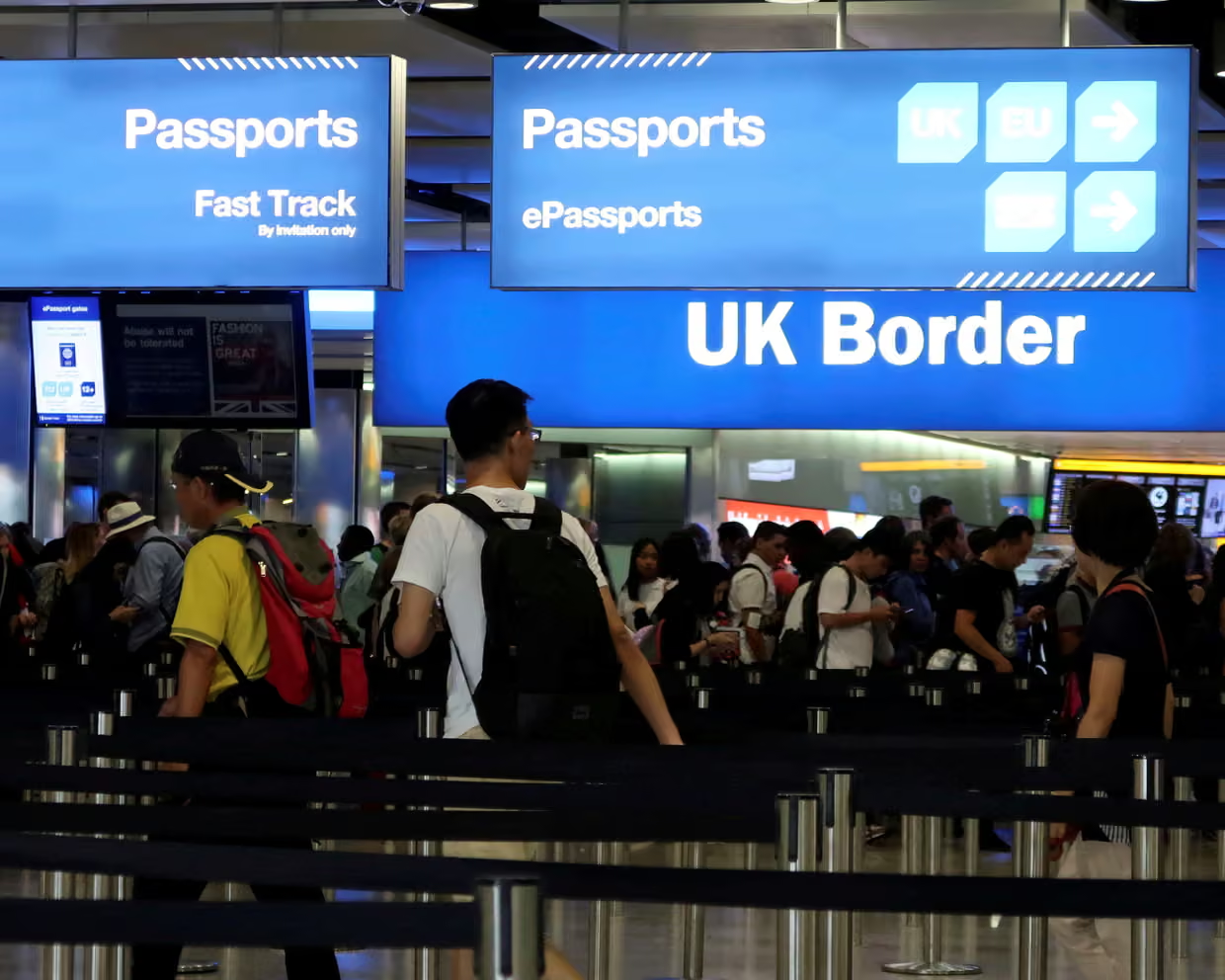
University of Hertfordshire placed on UK Home Office student visa action plan
The UK’s tightening of Border and Compliance (BAC) standards is beginning to impact higher education institutions (HEIs), as the University of Hertfordshire becomes the latest university placed under a student visa Action Plan, according to Times Higher Education.
The University of Hertfordshire joins other institutions, including the University of Essex and Glasgow Caledonian University, which were added to the list earlier this year. The University of Central Lancashire has been under a six-month plan since last year. De Montfort University and Nottingham Trent University were placed on similar plans but have since been removed. Several private and alternative providers remain under restrictions.
What Is a Student Visa Action Plan?
A student visa Action Plan is a formal compliance mechanism used by the UK Home Office to address concerns over a university’s adherence to sponsor licence requirements. When an HEI is placed on an Action Plan, it indicates that the institution has fallen short in one or more areas of its sponsorship duties—typically relating to visa monitoring, record keeping, or student attendance.
Under the plan, the university must take corrective steps within a defined period, often three to six months, to demonstrate full compliance. This process includes tightening internal processes, verifying student engagement more closely, and ensuring that all international students meet the conditions of their visas. Failure to comply can result in further sanctions, including suspension or revocation of the sponsor licence, which would prevent the institution from recruiting new international students.
Institutions with large international cohorts from Nigeria, Pakistan, and Sri Lanka face heightened scrutiny under the new criteria. However, compliance experts stress that no university is exempt. At least eight HEI sponsors have been placed on Action Plans in the past 12 months, underscoring a sector-wide tightening of oversight.
The Home Office’s compliance approach is intended to safeguard the integrity of the UK’s student visa system. Persistent breaches can lead to the loss of a sponsor licence, significantly damaging a university’s reputation and its ability to attract international students. The impact could extend to the wider higher education sector, which relies heavily on international enrolments for revenue and cultural diversity.
Share on:
Recent Articles
Recent Articles

New Primary and Temporary worker sponsor guidance
New Primary and Temporary worker sponsor guidance On 11 November 2025, the UK Home Office issued updated versions of three Primary Worker and Temporary Worker sponsor guidance documents. These updates

England’s universities face £330m loss under new £925-per-international-student levy
England’s universities face £330m loss under new £925-per-international-student levy The UK government has set out plans for a £925 charge per international student from 2028, with its official modelling indicating

UK minister flags visa ‘abuse’ as student asylum claims surge
UK minister flags visa ‘abuse’ as student asylum claims surge UK’s Indo-Pacific Minister Seema Malhotra has defended her government’s immigration proposals during a visit to India, while expressing concern about a rise

No permission, no travel: UK set to enforce ETA scheme
No permission, no travel: UK set to enforce ETA scheme From February 2026, visitors will not be able to travel to the UK without advance permission. Visitors from 85 nationalities,

Elon Musk says that in 10 to 20 years, work will be optional and money will be irrelevant thanks to AI and robotics
Elon Musk says that in 10 to 20 years, work will be optional and money will be irrelevant thanks to AI and robotics The Tesla CEO said at the U.S.-Saudi Investment Forum in Washington,

Immigration changes will ‘profoundly impact’ Scottish care workers
Immigration changes will ‘profoundly impact’ Scottish care workers Making legal migrants wait longer before settling permanently in the UK would have a “profoundly negative impact” on Scotland’s care sector, it