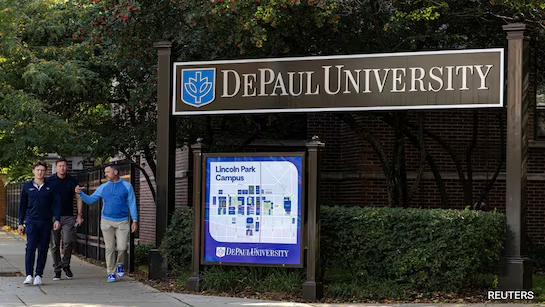
DePaul University has told faculty it will immediately reduce spending following a 30% decline in international enrollment this fall. The move is the latest by US colleges to cope with the disruptive education and immigration policies of President Donald Trump.
The amount of the reduction is to be determined, but measures could include a hiring freeze, executive pay cuts and discretionary spending limits, university president Robert Manuel wrote in a memo to faculty on Tuesday.
Overall international enrollment at the private Catholic university in Chicago decreased by 755 students compared to last year, Manuel said. The number of first-year international graduate students fell at an even steeper pace — by nearly 62%. DePaul enrolled some 21,000 students last year, about 2,500 of them from abroad.
Manuel attributed this year’s decline to students having difficulty getting visas and losing interest in studying in the US following changes in federal policy.
DePaul is among dozens of schools that have announced budget cuts in response to Trump administration policies that are upending higher education. That includes threats to billions of dollars of funding for academic research programs, many of which act as strong lures for students from abroad. Complete enrollment figures are not yet available, but early numbers collected by Reuters suggest many first-year international graduate students are choosing to study elsewhere.
Student visas also have been in Trump’s crosshairs. Some visas have been revoked, and students seeking new visas have faced delays. The US State Department has required prospective students to make their social media accounts public so government officials who vet visa applications can screen out students deemed to have hostile attitudes toward the United States.
In May, the administration blocked Harvard University from enrolling international students after saying the university failed to address antisemitism and ethnic harassment on campus. A US district court temporarily blocked the action, but the government has filed an appeal.
“We are all worried about the safety of our community members, the safeguarding of academic freedom, and the new financial challenges driven by changes in federal funding and visa processing,” Manuel wrote to DePaul’s faculty. “These concerns are so severe and debilitating that it’s getting hard to recognise higher education anymore.”
Asked for comment, the US departments of state and homeland security sent statements noting the government’s right to police the actions of students studying from abroad.
“This isn’t that hard,” said Tricia McLaughlin, assistant secretary at the Department of Homeland Security. “If you are living and studying in the United States on a visa, you are a guest in this country. Act like it. If you are a foreign student pushing Hamas propaganda, glorifying terrorists that relish the killing of Americans, harassing Jews, taking over buildings, or other anti-American actions that we have seen lately on these campuses, you can book yourself a ticket home. You can expect your visa will be revoked.”
At least 35 other schools, in addition to DePaul, have announced budget cuts in response to Trump administration policies. Johns Hopkins University slashed more than 2,000 jobs in March after the administration cut $800 million in grants to its research programs. Northwestern University cut 425 positions, and the University of Southern California laid off more than 630; each cited reduced federal funding, an expected drop in international student enrollment and other financial pressures.
Federal Policies Influence Student Decisions
In interviews with Reuters, some students cited federal policies in explaining their enrollment decisions.
A student from India who was accepted to the University of California, Davis, said she decided to defer admission and is considering other options because of uncertainty about getting a student visa. “My parents were also scared that I might get deported or something if I go right now,” she said.
A Chinese student who graduated from Northwestern University in 2024 was accepted to a US program to pursue his PhD in economics, but he said he decided to enroll in the United Kingdom because of uncertainty surrounding visas, combined with precarious research funding.
“Except one of my professors, all of them suggested that if I have a non-US option, I should think about it carefully,” he said. “So I made that choice.”
Early Numbers Show Decline
Some 1.2 million international students studied in the US during the 2024-2025 academic year, according to estimates from NAFSA: Association of International Educators, a non-profit organisation. In July, NAFSA projected that number would drop by up to 15% this year, costing the US economy nearly $7 billion.
With universities still tallying their fall enrollment, it is too soon to compile nationwide data. The number of international students studying in the US this month is down 2.4% from last September – from 965,437 to 942,131, according to data from the Department of Homeland Security’s Student and Exchange Visitor Program. These numbers do not paint a full picture, however, because the number of incoming and outgoing students is in flux, and some schools have not yet reported their fall numbers.
Reuters spoke to administrators or spokespersons at 10 schools with consistently high foreign enrollment. All report declines in overall international student enrollment – ranging from a 1% dip at the University of Illinois Urbana-Champaign to a 19% drop at the University at Buffalo. Illinois has enrolled 13,268 international students, and Buffalo has 4,087.
Both schools enrolled more international freshmen this fall. But steep declines in the number of graduate students enrolling from abroad drove their overall foreign enrollment totals down. The decline was most pronounced among first-year graduate students. Illinois Urbana-Champaign has seen a 22% drop and Buffalo, 58%.
Any decrease in enrollment among first-year students has a compounding effect, said Dr. Fanta Aw, executive director and CEO of NAFSA. When admitted first-year master’s program students opt not to enroll, a school loses their tuition for two years.
Exacerbating that pain is the fact that many international students are ineligible for financial aid and thus pay full tuition. They are an important revenue source for many schools seeking to offset decreasing domestic enrollment, increasing operating costs and cuts to government funding.
On Wednesday, the Trump administration asked universities to sign a deal that could squeeze many schools even more. It seeks to cap international undergraduate enrollment at 15%.
“Universities that rely on foreign students to fund their institutions risk, among other things, potentially reducing spots available to deserving American students,” said a memo to universities shared with Reuters by a White House official.
In June, credit ratings agency Moody’s warned that falling enrollment could present a credit risk for some schools. Among the most vulnerable, it reported, are schools with graduate programs that rely heavily on international students. That dependence has grown over the past decade, the report said.
“Graduate students often pay higher tuition fees for certain programs, so the loss of these students could have a particularly severe revenue impact,” the report said.